


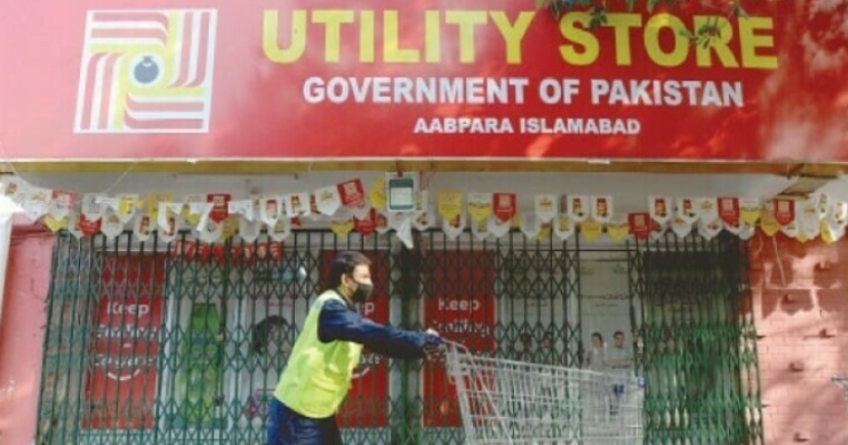
Utility store workers are finally getting their severance dues. What was the hold-up?
After months of tension and uncertainty, the dispute over overdue compensation between the Utility Stores Corporation (USC) and its recently laid-off employees has reached a conclusion. The management of USC, along with the All Pakistan Utility Stores Corporation National Workers Union, has agreed on a compensation package worth Rs 25.5 billion, aimed at settling the dues for over 11,000 employees affected by the government’s decision to shut down the USC project. The payment will be disbursed in three phases, with Rs 19.5 billion allocated for the employees’ dues, and the remaining Rs 5.75 billion designated for widows and other terminal claims. In return, the Union has agreed to accept this payment as the full and final settlement of all claims, ending their agitation and agreeing not to pursue any further legal action.
This long-overdue settlement comes after the workers had protested for several months, demanding the disbursement of dues that had been promised but were not paid despite being announced by the government a month earlier. With this issue now resolved, the employees will finally receive the severance they’ve been waiting for, bringing closure to a saga that had drawn much attention due to the government’s decision to wrap up the USC project, which had been a cornerstone of state welfare initiatives since its inception.
Utility Stores were instituted in Pakistan as a state-backed measure to provide household goods at subsidized prices to those who could not afford them. They became a widespread emblem of state-backed welfare initiatives to make lives easier for the common person.
But, especially in the past decade or so, the institution had come under fire for not only being inefficient and embroiled in corrupt practices, but also because of the simpler reason that it was making massive losses. In fact, by the time the whole Utility Stores program was wrapped up in July 2025, the cumulative loss had amounted to around Pkr 24 billion. At the same time, it was not even clear that the subsidies given by the government were being passed efficiently to the consumer.
The government finally decided to call it quits on the whole project in July 2025. Yet, while this measure was justified, considering the losses the program was racking up, this step must not be considered a simple abdication. Rather, new avenues must be found to facilitate the achievement of the same objective, but through better, more efficient means.
A Well-Intentioned Failure
The Utility Stores Corporation was established in 1971 by acquiring 20 retail outlets from the Staff Welfare Organisation. As a state-owned enterprise, it was geared primarily towards low-income households, whom it intended to benefit by offering household necessities at subsidized rates. In 2007, this network of – essentially – mini-supermarkets went through a major expansion at the Union Council level. This resulted in the increase of the number of outlets from 1023 to 5557 by 2009. Concurrently, the number of employees also rose from 3892 to 12749 during the same two-year period.
Of course, this rapid expansion necessitated even greater government subsidies, since the number of stores – and hence the products sold – had risen manifold. While this system could have worked, provided that the expansion had been well-planned and well-executed, it did not prove to be the case. Reliant on obsolete price assessment and implementation models, poor warehousing and supply chain mechanisms, and the absence of a centralised enterprise resource planning system, the whole system was falling on itself.
Since it was the taxpayers who were paying for it – for their own eventual benefit, granted – the fact that the whole engine was wearing down was certainly a big cause for concern. Yet the system kept functioning: the government kept pumping money, and pushing the prices down, though often the stores were not functioning as envisioned.
Occasionally, complaints would arise that certain products were not there, or that the products were of subpar quality, or that the products were even more expensive than the regular market, or that the consumers were prevented from shopping for more than one type of good per visit. But, this remained, by and large, the biggest avenue through which the government disbursed its Ramadan packages to the populace.
These inefficiencies were, however, exacerbated by the frequent cases of malfeasance and corruption by the employees as well as the management of the Utility Stores Corporation. In 2018, it was reported that over 50 cases of corruption had been registered in the preceding five years against certain operators of Utility Stores in federal and provincial jurisdictions. In 2021, it was reported that there were about 2000 ‘ghost’ employees getting salaries, none of whom had been registered.
In the same year, the Auditor General’s office found irregularities of billions of rupees in the funds used by the USC. These irregularities included sums worth Pkr 14.8 billion in the sale and purchase of sugar during the FY20. This was on top of losses of Pkr 2 billion in sugar transactions and Pkr 64 crores in the receipts of flour buying. At the same time, hundreds of rupees were reported as having been embezzled by the employees. The government dismissed – again, in 2021 – Zulqarnain Ali Khan who was the chairman of the USC over his alleged misuse of authority.
It was going the way of the Pakistan Steel Mills – operational inefficiencies met incompetent and corrupt management. Public coffers – even if intentioned for the public good – can only bear so much. For instance, FY 2013-14 was the last time the USC was able to turn a profit. And, on top, if it is not even clear that the purpose was being served, it makes sense to reconsider the whole project.
And that, the government did.
The Reckoning
In August 2024, it was reported that the Ministry of Industries and Production was considering shutting down all the utility stores, and to then privatise the USC. This proposal was a part of the ongoing effort to rightsize federal ministries and the institutions that fell under their purview. By September, the USC had been placed by the federal cabinet in the list of state-owned enterprises to be privatised. At the same time, subsidies that had financed USC’s operations were withdrawn.
When the thousands of employees got wind of what the Secretary of the Ministry for Industries and Production, Saif Anjum, had said, they flared up in protest. Upon that, the Minister for Industries and Production, Rana Tanveer Hussain, explained that there were, in fact, no such plans to close down Utility Stores. Instead, what would happen is merely a ‘restructuring’. Yet, as it turned out, the initial statement was the correct one. The government did intend to shut the USC, and to privatise the whole enterprise.
In January 2025, the federal government formed a high-level committee to formulate a strategic plan to close all Utility Stores in the country. This obviously involved planning what to do with the over 11,000 employees (including permanent and temporary staff) the USC had at the time. Similarly, the debts and liabilities owed by the USC also needed a plan to settle, and so did the excess inventory in the warehouses.
By April 2025, it was reported that the government was quickly closing down Utility Stores as part of the privatisation move. At that point, under the plan, it had closed over 1200 store outlets, and laid off over 2200 employees. The government, at that point, announced that it planned to keep no more than 1500 stores in operation, and those too, only on a commercial basis. Over 2800 employees from grades 1 to 13 were slated to be axed in the second phase, whereas those on higher pay grades were to be transferred to a surplus pool.
The IMF too chimed in, of course, and directed the government to close over 1000 store outlets, and reduce the workforce by the end of June 2025.
Two options were presented to the Prime Minister on how to go about deciding what was to be done with the USC. The first option was for a Pkr 14 billion bailout to stabilise the operational cash flows. The other option was to just shut the whole shop down. On July 2, the government formally announced its decision to close the USC operations down by the end of the month. And on July 31, the USC formally ceased operations, with all sales and purchases at Utility Store outlets coming to a final end.
The only operations that would continue concerned the movement of stock from stores to warehouses, returning them to vendors, and handling the stores’ inventories. The company announced that by August 31, it would lay off the majority of its workforce, while 832 employees would remain on the payroll till November 2025 to take care of inventory and warehousing. This workforce would then be reduced further in December to facilitate property disposal and any residual tasks.
By the end August, the Economic Coordination Committee of the Cabinet approved a technical supplementary grant of over Pkr 30 billion. This grant was intended to cover severance, salaries, and any dues the USC owed as liabilities. The government also announced its plans to sell off the company’s assets – including properties – to finance the closure as well as cover costs of final operations.
Yet, in September 2025, the government announced that, contrary to its prior plans, the contracts of all employees would be terminated and all 11,406 of them would receive a government-approved financial package. As part of this package, the government announced that it had finalised a Pkr 25.5 billion package for the affected employees. And it was the non-payment of this sum that had agitated the workers’ Union. And this was the amount the government, this week, finally agreed to pay in three phases.
Meanwhile, the government formally took the USC off its privatisation list in November 2025. The liabilities exceeded overmuch the remaining assets, meaning the selling it off into private hands was not feasible.
Like other state-owned enterprises, such as the Pakistan Steel Mills, the USC too fell awry. Years of operational inefficiencies, subpar management, and corrupt practices had taken their toll, and what was one envisioned as a comfort for the taxpayer ended up becoming a massive burden for them.
What must be said here is that although the decision to wrap operations up was reasonable, it must not be the final step in this direction. Instead, alternative mechanisms, that are more thoughtfully managed, must be put in place to not only supply the void left by the closure of this enterprise, but also to improve upon it, and make things easier for the general public. Whether it would mean making such proposed enterprises being run through a public-private partnership, or solely private models subsidised by the government, remains to be seen, but the need for another better alternative cannot be discounted.